Building Zephyr

Zephyr is a 10' cedar-strip sailing dinghy that I designed and built in 2017. She served as our tender on Summer Breeze, our nonsuch 30 sailboat as we explored the Inside Passage and circumnavigated Vancouver Island.


Zephyr was built as part of the Edensaw Challenge, a boat-building contest sponsored by Edensaw Woods. The premise of the contest is to build a boat in two and a half days. I decided to try the impossible and build a cedar strip boat. Everyone told me that it couldn't be done. But the more I thought about it, the more convinced I became that we could accomplish it. So I set about to design the boat in earnest. My goal was to build a useful boat that could be marketable once built. Zephyr is the result.
I had no experience designing or building boats before I set out on this challenge. If I had, I probably would have known better. Everything about this build was a research project. Literally, everything was unknown, but that's what made it so fascinating to me. I knew that similar boats have been built for centuries. The techniques are out there, and I had Google at my disposal. My approach was definitely old-school. Instead of using 3-dimensional CAD (which I don't have), I carved a quarter-scale half-hull model of the boat and took the lines directly off the model. From those lines, I was able to build the forms.


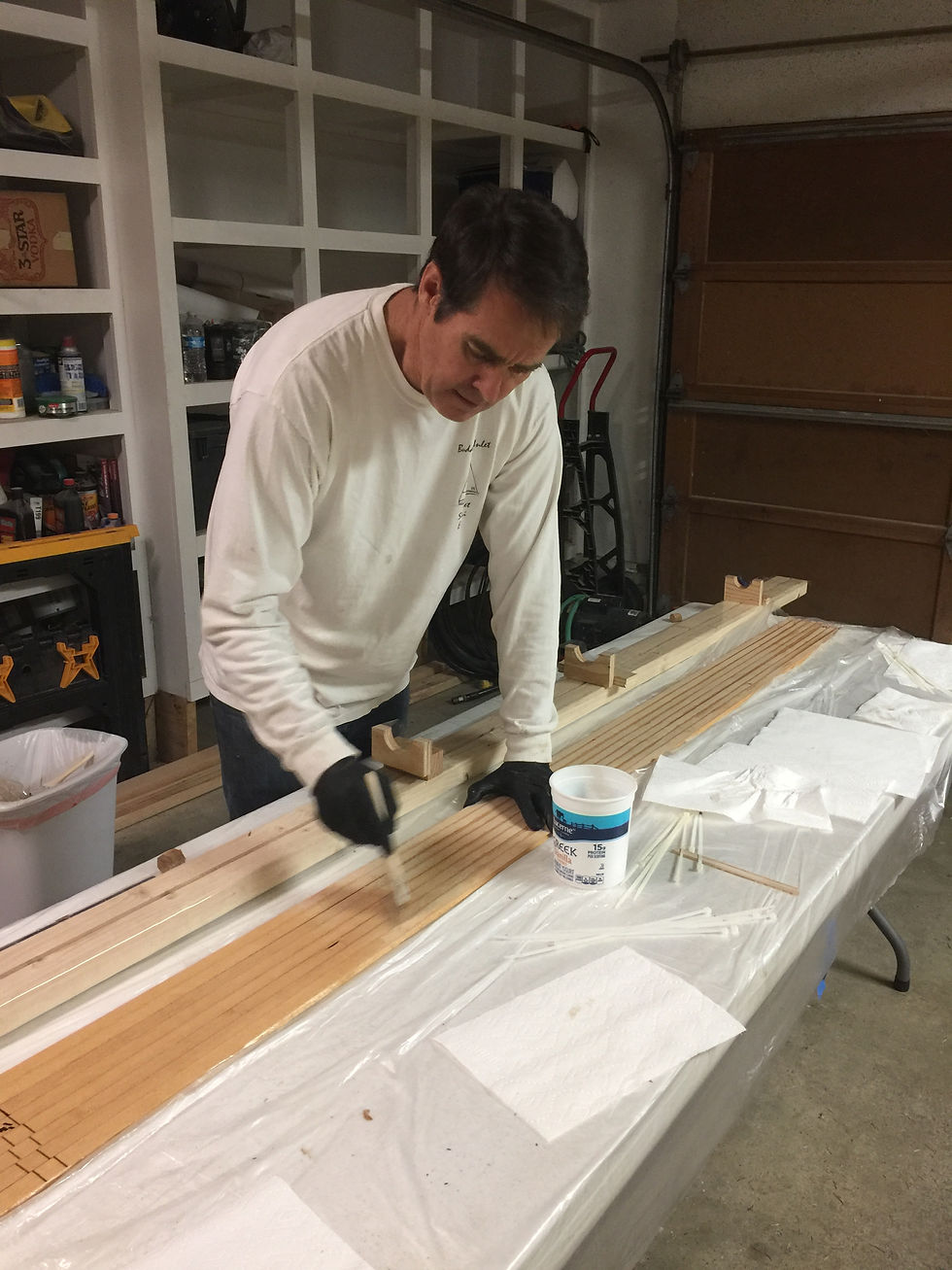
We arrived at the competition with the forms all fastened to the strong-back, ready to have the strips applied. A big shout-out to Eric Egge here. He supplied all the cedar strips and helped us machine them to size, including the cove-and-bead edges. He had salvaged a cedar log off the beach and had it milled to usable lumber. He was also a very knowledgeable ear, having already built a cedar-strip canoe himself. I don't think he believed that we would succeed, but he was very gracious about helping us out in every way (other than actually building the boat). The process includes simply stapling the strips to the forms, and edge-gluing them to their neighbor. Sounds easy enough, right? Not quite. The first 9-10" went on easily. After that, the strips had to be twisted more and more as they were bent around the forms. Each one resisted more and more.

Our team included me, my wife Fran (left), Craig Persons (right), and Barbara Emmonds. We worked from 9:00 am until 11:00 pm each day. This was after only an hour of work. At this point, we're psyched. This is easy!

Applying the strips is still going smoothly. Zephyr is starting to take shape.

Rut Roh! This is getting hard. At this point, we're 4 hours into the competition. Progress is slowing. The strips are complaining, but we're forcing them to behave. A few more, and we'll need to start steaming them. That introduces all sorts of problems. One, the strips are wet when they are steamed. Two, we are using Titebond glue, which is water soluble. But I thought of that! We switched to gorilla glue for the bottom. Messy, but it works.

Problem. Our steamer didn't work very well. The strips fought us all the way. We finally won, but we spent way too much time closing the bottom. We had to get the first coat of fiberglass on by Friday night. That didn't happen. We weren't able to complete the challenge. I wasn't willing to do a crappy job to get to the finish line, so I withdrew from the competition. But we finished getting her stripped and sanded. The audience loved us. We drew a huge crowd. They were all rooting for us to complete her. A better steamer and we would have succeeded. But now I have another technique in mind called the top-hat technique that would have also solved our issues.


Zephyr came home and took a backseat to a kitchen remodel for a couple of months. Each night I would return from work and look at her in the garage, half expecting that the strips would have gone 'Sproing!' and ended up in a pile on the floor. It's the fiberglass that holds it all together. Finally, three months later, I finished her up. It didn't take long, though I only had an hour here and there to commit to it.


Okay, she's done as far as I was going to take her in the competition. But look at her lines! That's a sailboat! Back to the drawing board to design a sailing rig. To make this more interesting (only an engineer would say that), I decided to make a daggerboard and rudder that featured actual foils. Most small sailing dinghies just have a flat piece of plywood rounded on both edges. Not good enough for an engineer. I had to research what the correct foil shape should be, how to draw it in AutoCAD, then how to translate that shape to a piece of plywood. Lots of fun! I used four layers of 1/4" 5-ply plywood all glued together as my blank. My reasoning is that it gave me way more layers than using a 1" piece of plywood. I needed those layers as guidelines as I shaped the foils. I then glued the foil template to the end, and used my table saw to cut grooves in the plywood that just barely touched the template. These grooves were the markers I used to shape the foil as I planed away the wood. In fact, I painted the grooves so they would stand out. I planed away the wood until the paint started to disappear. Then I sanded it smooth and fiberglassed it. La Voila! Perfect foils!


The mast was even more fun in a weird sort of way. Yeah, any other dinghy would have a solid wood mast, and it would work just fine. But I'm an engineer. Can you say anal-retentive three times fast? No, I had to make a hollow mast, to keep weight aloft to a minimum. Un-huh. Like anyone cares. Even the boom is hollow, and it's maybe an inch and a quarter in diameter. How much weight did I save? Who cares. It's all about the process. The mast is made of Sitka spruce for lightness and strength. It is built out of eight lathes to form an octagon, each interlocked with its neighbor in a groove cut into its edge. Sounds easy enough, right? Well... It wasn't that hard. It's all on Google. But to make it harder, I designed the mast with a constant taper from bottom to top. So, all the lathes had to be tapered. I had to figure out how to use a table saw to cut tapers. Thanks again to Eric Egge for teaching me how to do this. Is it hard enough yet? Nope. I had to put a slip-joint in the middle so I could take the 16' mast apart to store within the dinghy. I found a commercially available slip-joint that I could glue in the middle. Technically, the slip-joint actually simplified the build. Now I could do two 8' halves rather than one 16' mast. Imagine trying to cut 16' lathes at a taper. Or even trying to handle them as I assembled it all.




I forgot to take pictures of the finished masts. From this stage, I planed off the corners and made it round, then varnished it. I had intended to put fiberglass on it for strength. Eric didn't think I needed it, and I really didn't have time anyway. We were due to get underway on our voyage up the Inside Passage.
So how did she turn out? The hull weighs about 75 pounds, 50 pounds lighter than a Minto dinghy or a Knobby Knees dinghy. My old dinghy was a 7' Livingstone which weighed 120 pounds and rowed like a pig. Zephyr rows incredibly well, except that the original oarlocks were way too weak. I broke both on the very first stroke. After five years of use babying the oarlocks, I finally got around to replacing them with massively beefy oarlocks. Now I should be able to keep up with Fran on her Hobie kayak. Zephyr sails extremely well in the lightest breezes (her namesake). There's no hiking on this boat. The skipper sits on the bottom, keeping the weight down low. Okay, so he'll end up with a soggy bottom, but at least the boat is very stable, and the sitting position is very comfortable. Even at ten to twelve knots of breeze, the skipper stays on the bottom. Above that, I'd recommend not being on the water. After all, she is an open dinghy. If you capsize, that would be a problem. She has more sail area, a finer entry, and cleaner lines than the Minto dinghy, so she should be much faster. I'd love to race her in a mixed dinghy fleet to see how fast she really is. She's probably faster than the El Toro and the Penguin.


Comments